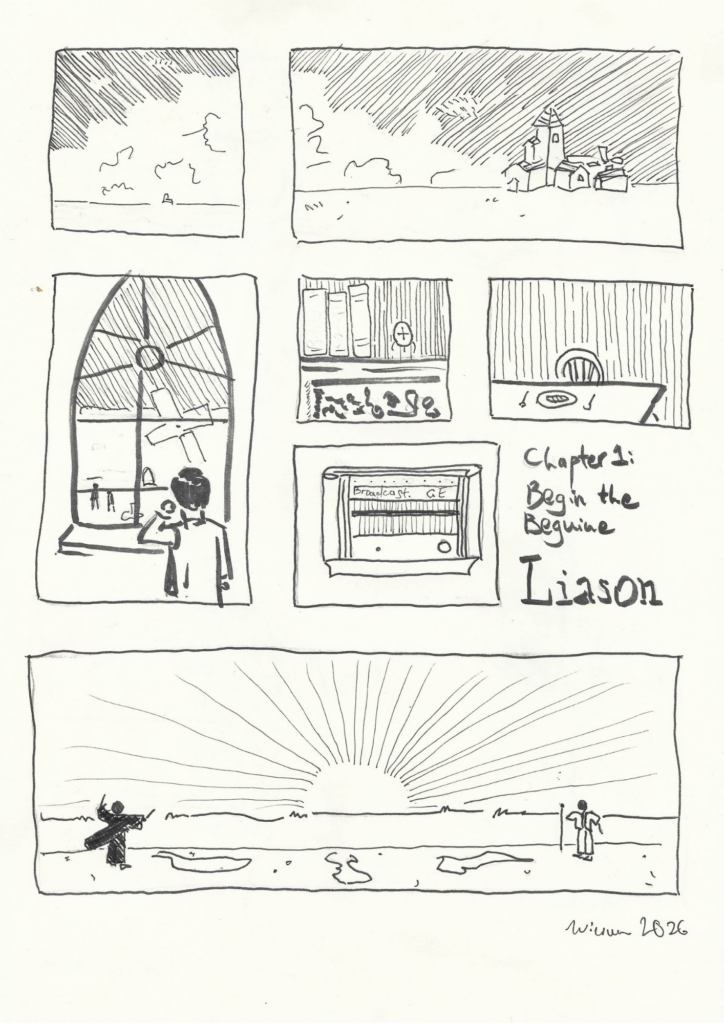
The greatest day of our protagonist’s life began with oranges. Once a week, Father would turn up the radio, let the boy into his office, and give him something new to eat. Father would sit in his chair like a king, his dark wizard robes flowing gently from his shoulders, and he would note down the description his boy would provide of the new sensation. Today, it was oranges.
“It tingles my tongue,” he said plainly, “and it tastes of the shield of Samix, scourge of orchards.”
“Curious.” Father would only ever reply thus. He never asked for elaboration, only held up his metal instruments in the air, and made further notes.
Earlier that morning, the boy had seen the oranges arrive from the vantage of his chamber on the third-floor turret of Father’s estate in Whitecross Mill. The room was meagre, with a thin mattress on a painted metal bedframe and little else worth boasting over. The little barred window from which he saw the oranges arrive looked out on a dirt ‘courtyard’ hemmed in by three other buildings – the black-brick millhouse and the two stout lodgings where all the gruff residents sleep. In the evenings, the foreman, Mr Ramm, would dole out the gruel to the accompaniment of a droning clarinet-song as the engineers and labourers milled about the pale and ruddy well. Someone would leave a tin of the stuff, dark and sludgy as mud, for the boy, and he would begrudgingly eat it in silence. He wasn’t allowed to speak to the other residents who laughed and fought and sung in the yard below; instead, he was left to his books (he only owned three, since he had managed to name them in one of Father’s experiments: the Holy Bible, the Odyssey, and then the Aeneid) and the grim outlook of the dining hall out onto the barren wastelands scattered upon which were dozens of dull bronze filters that captured the magic from the wind, funnelling it into the reservoirs in the mill.
In a word, the boy’s world was grey. Utterly grey. The only respite he received from his monotonous solitude came in the form of Father, who was often absent for months or weeks at a time, always to some new business expedition in some inexplicable town. The boy had once overheard Mr Ramm talk with gentle nostalgia about a place he called Canon City – a huge amalgamation of great civilisations, a complex of countless towering church spires and sprawling institutions and the most spectacular of vistas, being surrounded by acres of meadows and forestry both pleasing to the eye and sustaining of the belly – but when asked, Father simply explained with brevity that no such place could exist. Still, there was never any room for animosity when Father returned from his travels, since he always brought with him some new taste, some exotic texture, or even a pleasant painting on rare occasions. These exemptions to the repeating monochrome found at Whitecross Mill were joyous and simple and never were two gifts the same. Though the gifts could not remain on the premises, at Father’s insistence, they brought with them a whole new outlook to the week that shaped and redoubled every plain and unceasingly ordinary experience from the chrysalis of memory into a renewed creature of splendid memory. Even as he turned his thoughts over in bed, his senses naked to the darkened world of night, the tastes of cumin, the touch of velvet, or the tune of a pianoforte reached out to him from days prior, lifting him up into an ecstatic vision of the moment he first encountered its pleasure, carrying him along its length on wings of sonorous aetheriality as the symphony of his memories harmonised with one another, forming a veritable orchestra of recalled and redoubled phantasms which felt just as real as that initial introduction; he shook hands with the apple-skinned cellist, who shared a face with Perseus; he made jests with the violet-scented bugler, whose soft countenance was like that of Queen Victoria. In such a way he would meet each one of the players in the ensemble that was his youthful memory, taking note of who each member was and whom he had not yet been able to meet. He always seemed to fail to make the acquaintance of the faraway and faceless conductor before falling to sleep or stumbling across another distraction. Life still managed to take its fill of distractions, even when reduced to a dull pallor.
Today, as he returned his metal instruments to their leather case, a scent of vinyl oil, pure and discrete, accumulated about Father. Magic. An expression of recognition seemed to flicker on his wrinkled face before turning to confusion as he glanced at his watch on the table. Then, he became stoic again, his face returning to its typically emotionless neutrality.
“Will you show me some magic today, Father?” The boy stood, stretching his disused legs. He knew that that particular scent usually meant Father’s divinations were at work, and he would leave for his important work.
Father straightened his tie. “No. It seems I have a guest who has just arrived. Wait for me here and I shall return you to your chamber when I return.” With a satisfying flourish, Father turned for the door, his robe trailing in his stead.
Elated at the opportunity (rare as it was) to have Father’s office to himself, our protagonist leapt into Father’s chair. It was thick and wooden – ash probably – and had a velvet cushion on it that reminded him of St Peter. The boy had asked once why certain sensations reminded him of certain words, but Father simply explained that the entire point of the experiments was to find out. In other words, he did not know. The words always demanded to be spoken, and Father always seemed to recognise them himself. He seemed to like the proper names the best: Xanacras the Unbroken, St Andrew Nehpyr, the Archangel Gabriel, and today, Samix, the scourge of orchards. They seemed to satisfy him, though he would only ever crease his wrinkled brow and respond with ‘Curious.’
Now, the hand mirror was taken up from the long, heavy desk upon which instruments and books were strewn. The boy examined his reflection, proudly comparing the resemblances he shared with Father. They had the same hooked nose and grey eyes, but where the boy’s hair was cut short and dark, Father’s was perfectly silver and always slicked with pomade.
Bored, he began to roam the room. It was comfortably circular, with a quiet hearth at one end and a steel spiral of stairs at the other. The walls were lined with a waist-heigh cabinet and thick blue curtains which wrapped the entire space like a parcel. There was a handsome little photograph in black-and-white of Father shaking hands with a woman in a gown holding a wand. She’s probably one of Father’s guests, he thought, though he never met any of them. They were always received downstairs and in the salon, which was off-limits to him. Indeed, he rarely even left the building at all, being provided every basic need from within. Once, many years ago, the sunroom caught fire, and the boy had to flee the house to safety as the millers hurried to douse the space with water from the well. He had giggled and sped about the yard, shouting encouragements and orders to the men just as he’d seen Mr Ramm do as they worked. He smiled faintly to himself at the memory.
Suddenly, a flash of colourful lights seeped through the gaps in the curtains, along with yelling and a sensation all too familiar, yet entirely new – magic, yet this time dark and evil. Then, a malicious silence.
The boy froze. What could be happening out there?
The sound of the main door shocked him to action. In an inexplicable act of desperation, the boy rushed down the stairs into the main hall. Catching a glimpse of his Father’s white hair, the boy’s fears became softened, and he rushed forward into the antechamber.
Only to discover an unfamiliar face before him!
This new man appeared immediately wicked and cruel, his beady eyes and thin lips stretched into an awful smile that struck fear into our protagonist. His black cloak spanned the breadth of the opened door, steaming from several points where a hole was burning through. In his hand was a staff – a tall wooden shaft tipped with horn in the shape of a bell. Father’s staff. Once placid and inspiring, it now seemed malicious in the hand of this stranger.
The boy mustered his courage in his Father’s defence, “That isn’t yours!”
The stranger simply smiled down at him as he closed the door behind him, “You must be Orpheus.”
The moment of becoming was upon our young protagonist. He had never known a name, had never thought to need one. It was ever only the boy and his Father. Words were interchanged and names were not. But words thin and wear out, names are more resilient, stonework in the architecture of memory. In that second, the boy knew the stranger to speak true. He was Orpheus Whitecross, son of Grand Wizard Julius Whitecross. What an odd thing, to learn one’s own name, and to be told it no less, and then to be nameless never more.
Stunned, Orpheus could only nod.
The man approached more closely now. “Your Father has fled my might in the wake of our duel. He will not return.” The words sliced through Orpheus with fearsome violence. No truer words had ever been spoken, nor had they ever harmed so greatly the psyche of this poor lad. Unlike the enunciation of his name, which had been warm and familiar, this statement came icily. “Now, come with me,” the villain before him was saying distantly. He took a step forward, and suddenly Orpheus was snapped out of his trancelike desolation. Something came over him as he scuttled back from this invader, and his grim expression grew into a terrible scowl.
“Don’t come nearer!” Orpheus shouted. Then, “my Father will return! You’ll see…”
The vile man attempted vainly to adopt a gentle countenance as he said “Your Father is being kept away by very powerful magic, boy. If you come with me, I shall explain all. Then, we can—” He paused, his beady eyes trained strangely as if through the closed door, and his expression changed in an instant. After another fearful glance, he began to speak, more hurriedly now, “She is here. Time to go!”
With a raise of the staff and a shout of “Aυλιm!” he lunged for Orpheus, attempting to grab him by the lapel. Orpheus side-stepped just in time to hear a satisfying “zhum” as the offender seemed to pass into incandescent dust before his eyes. The dust dispersed into an indetectable wind, but not before Orpheus could steal from it the taste of green apple, rosemary, and an unfamiliar flavour. The name Hermeticus reached his mouth, but could not breach it, for it was incomplete, held back like water in a dam from breaching on account of that third unknown component which prevented him from discovering the full identity of the man who would now become his sworn enemy and sole quarry.
Orpheus fell back, broken. Where could Father have gone? Where could this Hermeticus character have disappeared to? Surely Julius Whitecross would return home to his son and to his Mill? But the vile conviction with which that man spoke… No! He mustn’t believe him. He couldn’t! Father would return, all that Orpheus need do was wait.
Orpheus was interrupted from his resolutions by the hurried appearance of a woman poised for battle, silver staff held upright. She wore a bright red dress with a little black jacket, and her grey hair was coiffed perfectly. Orpheus realised he recognised her from the photograph with Father, and a name sprung to his lips, “Vania Hrktos.”
Her concerned expression softened and she smiled pleasantly as she stood upright, flattening the front of her dress with her other hand. She spoke with a strange accent, similar to Father’s in some ways but wholly different in others, seeming totally artificial such as those put-on voices on the radio, though it came naturally to her elegant and elderly tone. “Why yes! You, dear boy, must be Orpheus? I understand your Father had had something of a scuffle.” She knelt down, placing a kind hand on the young man (for indeed, a young man he had become, a boy no more). Vania seemed to have comprehended instantly scene as she crossed the shattered threshold of Julius Whitecross’ estate, though her old friend had never shared anything regarding his son before. Still, this morning of the 24th of Quattor 1940, she received a premonition that Julius would suffer terrible and that an innocent would need her help. So, she rushed across the countryside to discover his fate.
All this she reported to the person on the telephone in Julius’ salon. It was a round black box with numbers on the front which seemed to put her in contact with someone called ‘operator’ (what a strange name!). Still, Orpheus was in such a state of shock that he barely registered the impermissible entry into this previously restricted room (which, admittedly, was in a sore state following the earlier duels, charred spots marking the green wallpaper, the fine furniture upended and shredded).
Soon, another man entered the room, which made Orpheus jump. Vania reassured him it was alright, introducing him to Civil Enforcer John Andestinic. It all seemed such a rush to young Orpheus, who had never spoken to so many people in his life, let alone in the span of an hour! He decided that Father would not be approve of his meeting so many people but determined that all would be forgiven if he could be rescued and returned home. He weighed up whether he should ask them for assistance in this task as he watched Vania and John discuss something at the window across the room. John was a rustic looking man with a dark shadow of a beard and a grey trenchcoat. His black, gnarled wand was thicker and shorter than Father’s pale and simple wand of antique length, which Hrktos had just before bestowed upon Orpheus. He eyed the silver inlay as he considered Vania’s offer to him: allow her to assume control of the Mill in Julius’ stead, join her in Canon City, and she would teach Orpheus magic. The thought was almost too much to manage! Canon City is real? He thought. I can learn magic like Father? Just the name of Canon City brought with it a plethora of imagined images to Orpheus as he pictured its grand streets and lofty buildings and it seemed still unimaginable to him that such a place could be real and that he might soon see it. But at the same time, the thought of leaving the Mill seemed an impenetrable barrier, not simply for the reason that Father might return in search of him, nor even that he might disapprove, but that the idea of living anywhere but his home was so foreign to him that he could not even fathom what might await beyond. Orpheus had long ago abandoned the dream that all prisoners nurse, resolved to spend his time immersed in memories of half-experienced days.
Mr Andestinic seemed in agreement about this. He was saying so quite clearly to Vania, “Archmage, I must object; the boy’s Father would not approve!” The pair spoke in hushed tones, but it was evident that Vania was being deliberately unsubtle. This was important enough for Orpheus to hear, even if John disagreed, as he did.
“Look at him, John. Orpheus has been held captive here his whole life. We have a duty of care now to protect him, and we can do that best from Canon City. Besides, he must be around 17 and a citizen of the United States while we’re at it. He has a right to freedom and a proper education, whether we like it or not.”
“So, it’s up to the kid then, whether he wants to join us in the windy city?” John asked, turning to face Orpheus at last. He spoke with a similar ‘Transcontinental’ accent to Vania, but there remained, detectable under the artificial speech patterns of the city, a rich, foreign manner of speech that reminded Orpheus of one of the Mill’s engineers from years back, who had apparently travelled from the east. “Whaddaya say ‘Pheus? Looking to ignite the spark of wisdom?”
Orpheus Whitecross, for the first time in his life, was faced with a genuine decision: to discard this little, false world for the sake of the (more) real, much larger world beyond, despite his Father but equally in service of him; or to remain at home, obeying his Father but forever wondering; in other words his decision was this: whether to live or to die, but in that life was the little death of what was before, and in that death was the false life of shadow and self-assurance. He considered this all deeply, weighing up the teachings of the Bible and his other books. On the one hand, a man must obey his father, but on the other, he must protect his family’s honour. Which was the right one? He considered the redemption of Thelonius (the Christ-figure of Orpheus’ Bible), how he had thrown off the mantle of emperor and crucified it – his own little death – in the name of casting off the demiurge of his violent life, taking up his new life as a holy man. Yet he also considered Odysseus, who left his home in the name of a promise; had he not wandered for many years, losing everything, only to return home to a place fully metamorphosed not just by time but by his absence? Then, he considered Aeneas. He had recognised that his home was destroyed, that his life waited for him beyond. So, he brought his father with him, and met his destiny in the great unknown, ever servile to his family and his faith. Orpheus stared down at his Father’s wand, his wand, its long shaft slightly longer than his thigh, and it seemed longer than he could possibly bear. But he could not deny that it was his destiny to bear, just as it was his destiny to return the wand to its rightful owner. He would not be leaving Julius Whitecross and his Mill behind, for Orpheus would be carry it all with him to this great, urban frontier.
Orpheus smiled up at the two Wizards before him. It was a rebellious smile, an eager smile, a resolute smile. Though it felt unfamiliar to him, though it pained him from lack of practice, he smiled, for he knew his destiny awaited him in Canon City. “Let me get my books,” he said. “Then we can go.”